

Project Delivery & Controls
Why Cash Flow Is Just as Important as Profit
July 14, 2026
Why the strongest construction companies treat cash flow as the result of disciplined operations, not just good accounting.
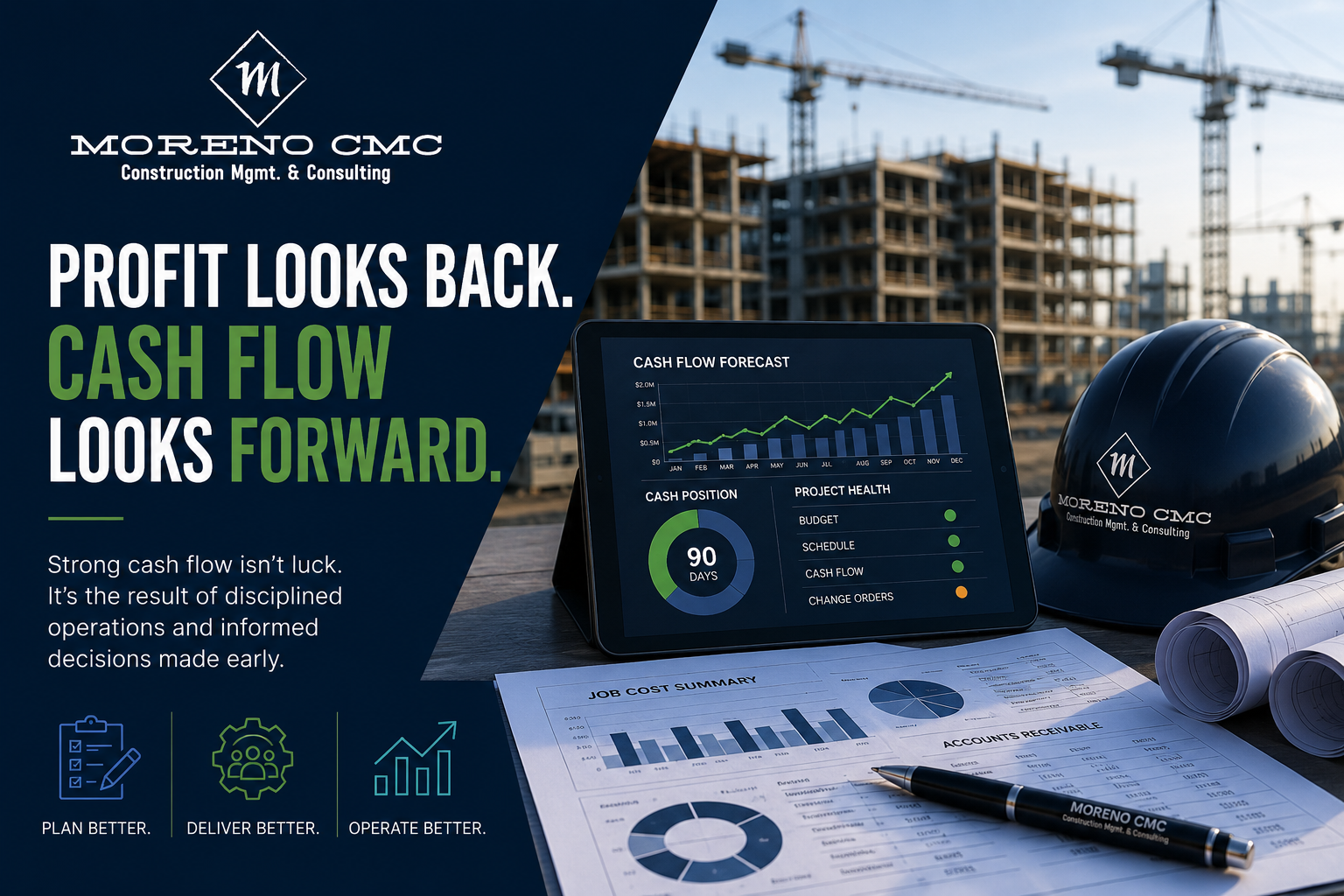
Most contractors know exactly what their profit margin is.
Far fewer know what their cash position will look like 60 or 90 days from now.
That gap matters.
I've seen companies that looked incredibly successful from the outside—busy crews, a backlog of work, and profitable projects on paper—still struggle to make payroll, delay vendor payments, or lean heavily on a line of credit just to keep moving.
The problem wasn't that they weren't making money.
The problem was that cash wasn't moving through the business the way it needed to.
That's an important distinction because profit and cash flow are related, but they're not the same thing.
A project can be profitable and still put tremendous pressure on a business if cash arrives too slowly or unexpected costs continue to pile up before payment is received.
Construction is one of the few industries where you're often expected to spend first and get paid later. Labor has to be paid every week. Materials need to be purchased before they're installed. Equipment is rented. Subcontractors expect payment. Insurance, permits, and overhead continue regardless of whether a pay application has been approved.
Every delay compounds the pressure.
A slow owner payment.
A change order waiting for approval.
An invoice that wasn't submitted on time.
A schedule that slipped by a few weeks.
Individually, none of those issues seem catastrophic. Together, they quietly erode the financial stability of an otherwise profitable company.
One misconception I see frequently is the belief that more work will solve cash flow problems.
On the surface, that makes sense. If money is tight, winning another project feels like the obvious answer.
In reality, growth often amplifies existing operational weaknesses.
Every new project requires additional labor, materials, supervision, equipment, and administrative support long before the corresponding revenue reaches your bank account. If the systems that support those projects aren't keeping pace, each new award increases the amount of cash your business has to carry.
It's a little like building another floor on a house without strengthening the foundation.
The structure gets bigger, but it also becomes more vulnerable.
That's why I rarely look at cash flow as purely a financial issue.
More often, it's an operational issue that eventually shows up in the financial statements.
When project information isn't visible until the end of the month, leadership loses valuable time to respond. When decisions rely on outdated information, small problems have a chance to become expensive ones. When processes vary from one project manager to another, consistency becomes impossible, and forecasting turns into guesswork.
The companies that consistently manage cash well aren't necessarily the ones with the highest margins.
They're usually the ones with the greatest operational discipline.
Their leaders understand what's happening across their projects before problems become emergencies. They don't rely on surprises or instinct. They build their businesses around visibility, accountability, and consistent execution.
Technology certainly helps, but software isn't the solution by itself.
The best technology simply makes good operations more visible.
If the underlying processes are inconsistent, software will only expose those inconsistencies faster. But when operations are standardized and teams follow a consistent approach, technology becomes an incredibly powerful decision-making tool.
That's why conversations about cash flow shouldn't begin with accounting software or financing options.
They should begin with a few simple question:
- How well does our business actually operate?
- Can leadership see problems early enough to act?
- Are projects being managed consistently?
- Is information reliable enough to make confident decisions?
- Are operational issues being identified before they become financial ones?
Those questions often reveal far more than a balance sheet ever will.
At Moreno CMC, we've found that improving cash flow rarely starts in the accounting department. It starts with stronger project controls, better operational systems, and the visibility to make informed decisions before small issues become expensive ones.
Because at the end of the day, profit measures how well a project performed.
Cash flow determines whether the business is healthy enough to keep building tomorrow.
Crafting Clear and Effective Scopes of Work for Construction Projects

What Do We Really Do?

Strategies for Fostering Strong Partnerships with Subcontractors in Construction